 Takes 2 minutes


Back to news
Stimulating team performance: the key role of design and interaction in the office
If you had asked a manager in the 1990s what the secret of performance and office team performance was, they would probably have mentioned a mix of strict hierarchy, fixed layouts and closed rooms. Today, no one believes in this anymore, not even those who, at the time, thought that open spaces alone were enough to create magic.
The real driver of performance is people.
And the fuel for those people is interaction.
Of course, work is evolving, habits are changing, environments are becoming hybrid, expectations are skyrocketing. Yet, despite technology, connected tools, collaborative platforms and video conferencing, one truth remains: nothing replaces spontaneous conversation, an exchange that happens while passing through a workplace, or the brilliant idea that emerges when two team members cross paths around a screen or a coffee.
This text explores how design, planning, layout, light, ergonomics, and even the quality of workstations deeply influence organisation, motivation, collaboration and the success of your teams.
And how to rethink offices not as containers, but as catalysts.
Understanding the impact of interaction on performance
Science is clear: research in behavioural psychology, management and neuroscience converges. Cooperation, exchanges and the feeling of belonging to a team simultaneously improve:
- productivity,
- creativity,
- problem solving,
- decision making ability,
- the quality of the work produced,
- employee satisfaction,
- and overall well-being.
Fluid interactions also reduce sick leave, strengthen culture, decrease fatigue, create engagement and even influence collective objectives.
It is no coincidence that high-performing companies are often those where there is a culture of constant conversation, an open environment, and spaces designed to encourage human connections.
Beyond these well-documented aspects, it is fascinating to observe that human interaction also generates a deeply emotional dimension. When a person enters a space where exchanges are fluid, their behaviour changes: they speak more, listen differently, dare to ask questions, propose ideas, ask for help. This spontaneous momentum is often invisible in statistics but perceptible in the atmosphere of a group.
In many organisations, it is unplanned moments that create the most significant breakthroughs. A simple detour to the coffee machine can be the starting point for an unexpected solution. A crossing of glances can trigger a conversation that changes the trajectory of a project. The design of a space can encourage these micro-interactions or completely stifle them.
Natural dialogues, shared emotions or improvised smiles are all signals that strengthen cohesion. They nurture a sense of belonging that is difficult to obtain through digital tools. And in a context where teams must adapt to changing rhythms, these organic bonds become a true stabiliser.
It is surprising to see how much a visual detail, a material, a colour, or an inspiring layout can influence people’s posture. A warm place encourages people to stay and to talk. A cold or impersonal place leads to withdrawal. Not underestimating these nuances means respecting the emotional intelligence of the physical environment.
Importance of exchanges and collaboration within teams
Interaction is not just useful: it is vital.
In a working world fragmented by travel, remote work, distance and different rhythms, the team must remain emotionally and intellectually connected.
When exchanges are spontaneous, authentic and regular, trust settles in.
When exchanges are forced, non-existent or overly formal, collaboration erodes.
Offices, when they are well designed, become anchor points: the place where informal conversations reveal what an Excel spreadsheet never shows. Individual objectives then turn into collective ambitions.
Influence of design and layout on communication
Design influences everything.
Good office layout can amplify collaboration by an incredible factor, while a bad one shrinks ideas, confines thinking, and reduces interactions to formal calls.
Design influences:
• traffic flow,
• the number of chance encounters,
• the way ideas emerge,
• ease of communication,
• comfort level,
• daily experience,
• and the overall feeling of being in a stimulating work environment.
Good design is not just aesthetic. It is a strategic lever.
Lighting, light, daylight, the warmth of materials, the silence created by sound-absorbing surfaces, good ergonomics, all of this influences the quality of relationships between people.
Challenges related to traditional workspaces
Traditional workspaces have three major flaws:
1. Invisible barriers that block cooperation
When teams remain isolated by function, they interact less.
Ideas circulate more slowly. Working conditions lose fluidity.
2. Fixed spaces that prevent adaptation
A fixed design reflects a fixed culture.
It becomes impossible to integrate new projects, or to adapt to changing work rhythms.
3. A lack of flexibility in space occupancy
Poorly exploited premises are costly and hinder performance.
We have entered a new era. One in which office spaces must be more agile than ever.
Another rarely mentioned difficulty concerns the collective perception of old spaces. Many organisations still operate in environments inherited from another time, designed for rigid management models where physical presence took precedence over real efficiency. This mismatch sometimes creates unexpected friction: the space reflects an outdated image while the organisation’s ambitions are modern.
It also happens that spaces that are too cluttered or overcrowded create mental saturation. The mind struggles to project itself, and creativity is hindered by fixed visual references. Conversely, a clean space or one structured with intelligently designed zones makes it possible to regain a more fluid dynamic.
Some older environments called for discretion, silence or compartmentalisation; but today’s teams are looking for more openness, transparency and fluidity in interactions. This is not simply a trend: it is a profound cultural evolution, influenced by technology, social practices and a new vision of relationships with others.
When more vibrant zones, a more welcoming territory or a warmer atmosphere are gradually introduced, the psychological transformation is immediate. Space becomes a tool for collective energy rather than a source of inertia.
Designing offices that encourage interaction
The objective: to create a place where teams want to come, where exchanges are natural, and where creativity flows freely.
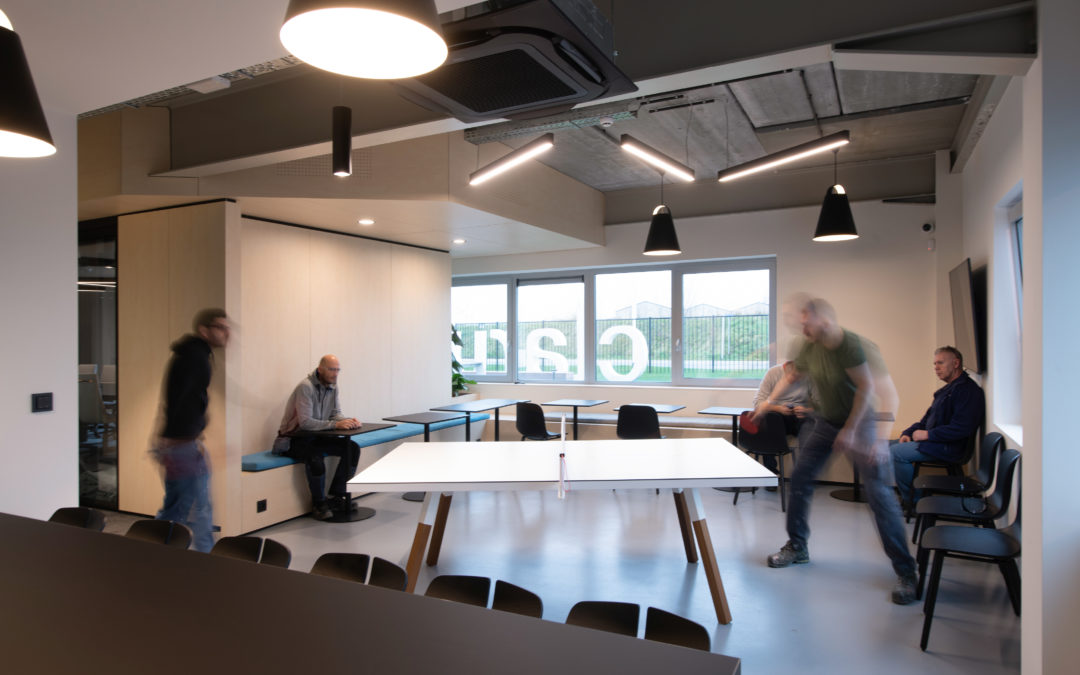
Layout of collaborative zones and open spaces
To stimulate collaboration, nothing beats open, accessible, modular zones.
Good layout encourages exchanges by:
• multiplying multifunctional areas,
• creating comfortable meeting points,
• blending circulation, relaxation and production,
• offering micro-spaces for quick discussions.
An open space is not an architect’s whim: it is a way to create connection, meaning and spontaneity.
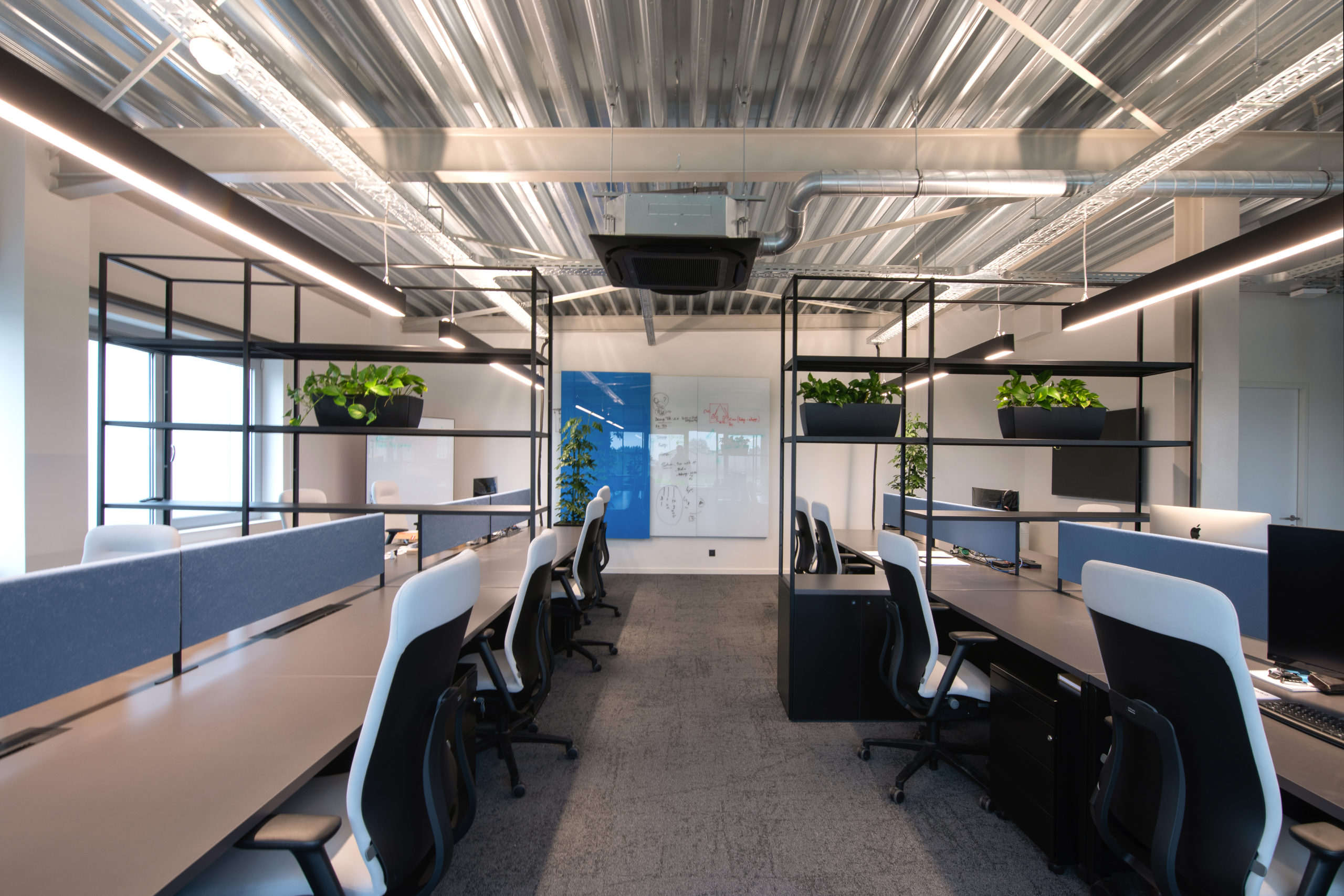
Modular and ergonomic furniture to facilitate exchanges
Furniture, furniture, furniture.
It plays a crucial role in the mobility of interactions.
Modular elements strengthen connection.
Adjustable workstations help to fluidify usage.
Office chairs, mobile tables, lightweight structures, translucent or pivoting partitions… all of this transforms a simple workplace into a vibrant space.
Ergonomics is not an option. It influences engagement rates, work sustainability and overall satisfaction.
Integration of technologies to connect on-site and remote teams.
Design is nothing without intelligent connectivity.
Teams, whether remote or on site, must feel integrated.
Technology facilitates:
• hybrid meetings,
• transitions between individual and collective work,
• fluid interactions,
• document sharing,
• cohesion in meeting rooms,
• access to shared tools,
• the completion of complex tasks by several people.
The quality of digital design is part of physical design.
Supporting teams and measuring effectiveness
Creating a space is not enough.
The human transformation must be supported.
Training and awareness of good collaboration practices
A successful change strategy includes training.
It explains how to use spaces, how to optimise interactions, how to strengthen team cohesion, how to streamline processes, how to bring culture to life.
Training turns intention into reality, and space into a tool.
Monitoring performance indicators and adjusting design
Indicators make it possible to measure:
• performance,
• team cohesion,
• actual usage,
• employee feedback,
• the relevance of the strategy,
• proper space occupancy.
When projects evolve, design evolves too. Needs change, behaviours adapt, and space must follow.
Adjustment is a continuous process, never a fixed result.
Promoting a team culture and continuous innovation
Culture shapes space, but space also shapes culture.
Promoting a collective dynamic requires:
• a design that makes people want to cooperate,
• an environment that amplifies creativity,
• an atmosphere that reduces fatigue,
• a permanent spirit of initiative.
Comfort, conviviality, light, circulation, breathing spaces… all of this influences human connections.
When space serves the team, the team serves the space.
A virtuous circle.
Creating interactive spaces with Meraki
At Meraki, we consider a good space to be a living, evolving, intuitive creation. Our design team collaborates with you step by step to propose a layout, a strategy, and a selection of elements adapted to modern practices.
We help organisations rethink their offices, strengthen connections between members, fluidify interactions, reveal benefits, and create a true environment for innovation.
With good office layout, every team gains meaning, every place gains impact, and every company strengthens its internal dynamic.
At Meraki, we believe that space is not decoration.
It is a tool, a partner, a driver.
And a powerful accelerator of success.
It is not uncommon for organisations to discover, after a few months, that their reinvented spaces generate positive effects they did not expect at all. For example, a structure that introduces versatile corners may see the emergence of internal communities: spontaneous think tanks, informal exchanges between departments, new social rituals.
Some teams observe that fluid interactions increase collective problem-solving capacity, as well as better onboarding of new arrivals. When a space naturally lends itself to encounters, integration becomes smoother and more intuitive.
More surprisingly, highly technical sectors also observe an improvement in discussions between different professions. The visual language of the environment encourages dialogues that previously required conscious effort. As people cross paths more often, culture becomes less hierarchical, more horizontal, more open.
These transformations have a direct impact on daily vitality. There is a gain in spontaneity, fluidity and joy in everyday life. And this joy is anything but anecdotal: it nourishes collective energy, stimulates the desire to contribute, and amplifies the impact of every internal initiative.